
A ball valve is one of the most widely used valves in industrial, commercial, and residential piping systems. It is designed to start, stop, or regulate the movement of liquids and gases through a pipeline. Because of its simple operation, reliable sealing performance, and long service life, the ball valve has become a popular choice for water treatment, oil and gas, chemical processing, HVAC systems, and general industrial applications.
In this guide, you will learn what a ball valve is, how it works, the different types available, common materials, and how to choose the right valve for your application.
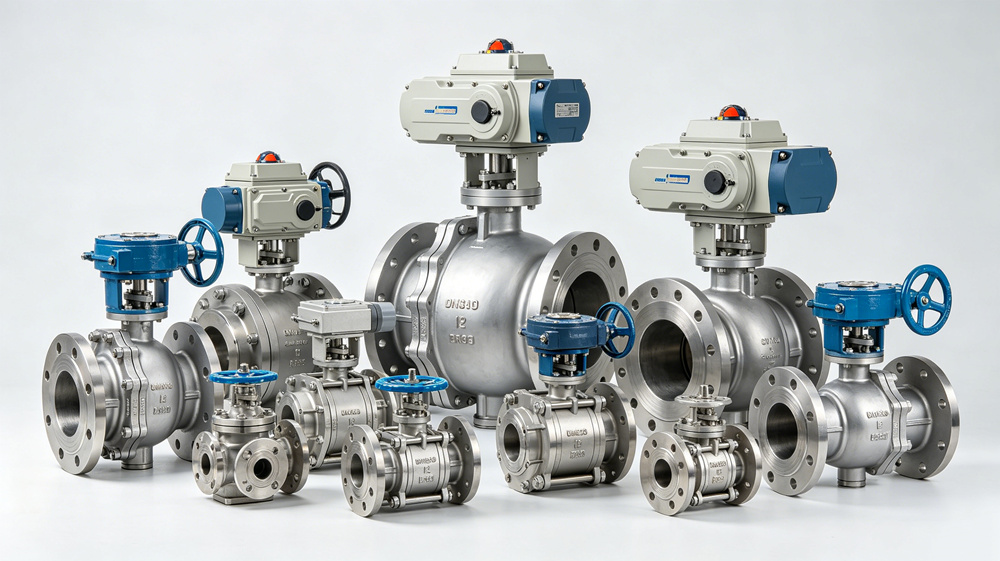
A ball valve is a type of shut off valve that uses a hollow, perforated ball to control the passage of fluid. When the hole in the ball aligns with the pipeline, the valve is open. When the ball rotates 90 degrees, the flow path is blocked, and the valve closes.
This simple design allows operators to quickly control water flow, gas flow, and other process media with minimal effort.
Because the valve only requires a 90-degree rotation to open or close, it is commonly referred to as a quarter turn valve.
The operating principle of a ball valve is straightforward.
The valve contains a spherical ball with a bore through its center. The ball is connected to a stem and handle.
When the handle is parallel to the pipeline:
When the handle is turned 90 degrees:
This quick operation makes ball valves ideal for applications that require fast shut-off capabilities.
A standard ball valve typically consists of:
The outer housing that contains all internal components.
The spherical element that controls flow.
Connects the ball to the handle or actuator.
Sealing surfaces that provide tight shut-off performance.
Used to rotate the ball between open and closed positions.
Different ball valve designs are available for various applications.
A full port ball valve has an internal bore that matches the pipe diameter.
Benefits include:
Full port designs are commonly used in oil and gas pipelines, water systems, and process industries.
A reduced port valve has a smaller internal opening than the pipe diameter.
Benefits include:
The ball is supported by valve seats and moves slightly under pressure to improve sealing.
The ball is mechanically anchored and supported at both ends, making it suitable for large-diameter and high-pressure systems.
Selecting the proper material is important for performance and durability.
Stainless steel ball valves are widely used in industrial environments because they offer:
Applications include:
A brass ball valve is commonly used in residential and commercial plumbing systems.
Advantages include:
Many modern brass valves are manufactured as lead free products to comply with drinking water regulations.
Often selected for high-pressure industrial applications where corrosion is less of a concern.
Although ball valves are mainly designed for on/off service, some applications use them for basic flow control.
However, standard ball valves are generally not recommended for precise throttling because partially open positions may increase seat wear over time.
For accurate flow regulation, a control valve is often a better option.
Ball valves are used in many industries because of their reliability and ease of operation.
Control and isolation of water flow in treatment plants and distribution systems.
Pipeline isolation and emergency shut-off systems.
Handling corrosive and hazardous fluids.
Sanitary systems requiring clean and safe operation.
Temperature and fluid management in heating and cooling systems.
Some industrial environments require heavy duty ball valves designed for:
Heavy-duty designs often include:
These valves are commonly used in power plants, refineries, and petrochemical facilities.
A push to connect ball valve simplifies installation by eliminating the need for soldering, threading, or special tools.
Benefits include:
Push-to-connect technology is becoming increasingly popular for water distribution and repair projects.
Ball valves offer several advantages:
These benefits explain why ball valves remain one of the most widely installed valve types worldwide.
When selecting a ball valve, consider:
Water, gas, steam, chemicals, or other fluids.
Ensure the valve matches the operating pressure.
Verify compatibility with system temperatures.
Choose between stainless steel, brass, carbon steel, or special alloys.
Options may include:
Select full port or reduced port based on flow requirements.
A ball valve is a reliable and easy-to-operate shut off valve used throughout industrial, commercial, and residential systems. Its quarter-turn operation, excellent sealing performance, and wide range of materials make it suitable for applications involving water flow, gas distribution, chemical processing, and many other industries.
Whether you need a stainless steel valve for corrosive environments, a lead free brass ball valve for potable water systems, a heavy duty valve for industrial service, or a push-to-connect design for quick installation, understanding the basics of ball valve technology can help you select the right solution for your application.
A ball valve is used to start, stop, or isolate the flow of liquids and gases in a piping system. It provides quick shut-off and reliable sealing.
A ball valve only requires a 90-degree rotation of the handle to move from fully open to fully closed, which is why it is known as a quarter-turn valve.
A full port ball valve has an internal bore that matches the pipe diameter, allowing maximum flow with minimal pressure loss.
Yes. Many modern brass ball valves are manufactured as lead free products and comply with potable water regulations.
Stainless steel ball valves offer better corrosion resistance and durability for industrial applications, while brass ball valves are often preferred for residential and commercial plumbing.
A ball valve can provide limited flow control, but it is primarily designed for on/off service. Control valves are generally better for precise flow regulation.
Heavy-duty ball valves are widely used in oil and gas, petrochemical, power generation, mining, and chemical processing industries.
A push-to-connect ball valve uses a quick-connect fitting design that allows fast installation without soldering, welding, or threading.