
To select a globe valve for precise flow control, start with the required flow rate, operating pressure, temperature, pressure drop, valve size, and fluid properties. Then select the valve body material, valve seat, disc design, bonnet type, and end connection based on the service conditions.
Globe valves are well suited to flow regulation because the disc moves linearly toward or away from the valve seat. This allows the flow opening to be adjusted gradually. Compared with gate valves, globe valves usually create a higher pressure drop because of their internal flow paths, but they offer better control when the process requires frequent adjustment.
For high pressure, high temperature, corrosive, or oil and gas service, the valve should be selected according to the complete operating conditions rather than pipe size alone.
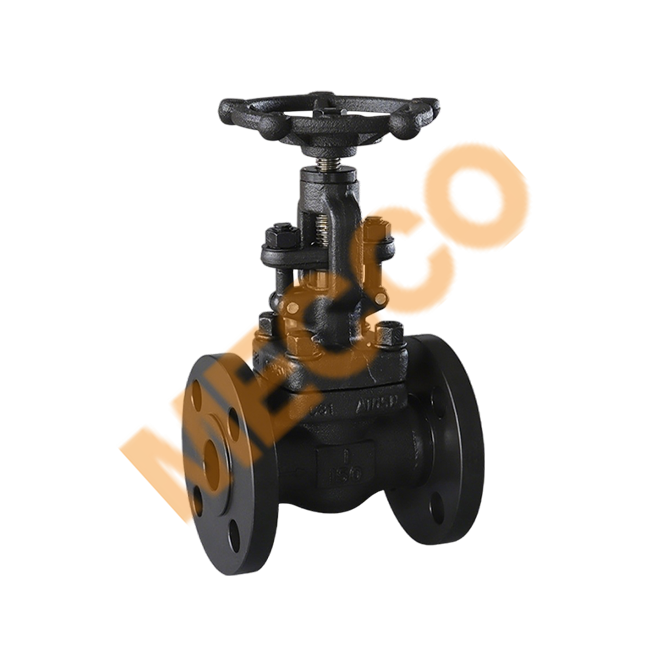
A globe valve is a linear-motion valve designed to start, stop, and regulate fluid flow. Its main components include the valve body, bonnet, stem, valve seat, and disc.
When the valve is opened, the stem moves the disc away from the seat. This increases the available flow area. When closing the valve, the disc moves toward the seat and reduces the flow area until the passage is shut.
This design gives globe valves good flow regulation characteristics. They are widely used in industrial piping systems where the flow rate needs to be adjusted instead of simply starting or stopping the process.
The internal design also creates more resistance than a straight-through valve. This results in a higher pressure drop, but the same flow resistance can help provide controlled throttling.
The main advantage of a globe valve is its ability to control flow through gradual disc movement.
A gate valve is generally intended for full opening or full closing. A globe valve, by comparison, can operate at different opening positions to regulate flow.
This makes globe valves suitable for applications that require:
A globe valve is not always the best choice for every pipeline. If low pressure drop and full-bore flow are the main goals, a gate valve may be a better option. If precise flow control is required, the globe valve design often provides greater flexibility.
The required flow rate should be one of the first specifications considered.
The valve needs to provide sufficient flow capacity at minimum, normal, and maximum operating conditions. Selecting a valve based only on the nominal pipe diameter can result in poor control.
Before selecting the valve, determine:
A valve that is too large may operate close to the closed position during normal operation. Small changes in the disc position can then cause relatively large changes in flow.
A valve that is too small may restrict the system and create excessive pressure drop.
The ideal selection provides enough capacity while maintaining a useful control range.
Pressure drop is an important consideration when selecting a globe valve.
The internal flow paths of a conventional globe valve force the fluid to change direction. This creates more resistance than a relatively straight flow path.
Higher pressure drop is not necessarily a problem when the valve is being used for throttling. However, excessive pressure loss can reduce system efficiency.
It may also result in:
The valve should therefore be selected based on both flow requirements and the available pressure differential.
For automated applications, the pressure drop should be checked across the normal operating range rather than at only one flow condition.
Valve size should be based on process requirements, not simply on the connected pipe size.
For example, a pipeline with a particular nominal diameter does not automatically require a globe valve of exactly the same size.
Valve sizing should consider:
Oversizing can make precise control more difficult. Undersizing can create excessive pressure drop and restrict the required flow rate.
For a control application, the valve should provide stable performance at minimum, normal, and maximum flow.
The valve body forms the main pressure boundary and comes into direct or indirect contact with the process environment.
Common valve body materials include:
Material selection depends on the fluid, temperature, pressure, corrosion conditions, and applicable standards.
A stainless steel valve body is often selected where corrosion resistance is important.
Stainless steel globe valves may be used in:
However, stainless steel covers many different grades. For example, 304, 316, and 316L have different characteristics.
The material should therefore be selected according to the actual process medium rather than simply choosing "stainless steel."
Carbon steel is widely used in industrial piping systems where the fluid and environment do not require higher corrosion resistance.
It can be suitable for many oil and gas, power, steam, and general industrial applications.
For high temperature service, alloy steel may be considered where its mechanical properties better match the operating conditions.
Temperature affects the performance of almost every valve component.
When selecting a globe valve for high temperature service, check:
High temperature can affect sealing materials, component clearances, packing performance, and material strength.
The valve should therefore be selected according to the actual temperature range rather than relying only on the nominal pressure class.
For steam, hot oil, process gas, and other high temperature media, the complete valve assembly should be checked for compatibility.
The valve seat provides the sealing surface against which the disc closes.
The seat affects:
The correct valve seat depends on the process medium and operating conditions.
Metal seats are often considered for demanding temperature, pressure, or abrasive applications. Soft seats may be suitable for applications where tighter sealing is required under compatible temperature and media conditions.
Seat selection should also be considered together with the disc. The seat and disc must work together to provide the required sealing and flow characteristics.
The disc is the component that directly changes the flow opening.
Its shape has a direct effect on the relationship between valve position and flow rate.
Different disc designs can be used for different operating requirements, including:
A standard disc may be suitable for general flow control. A specialized disc design can provide more controlled flow characteristics where precise regulation is required.
When selecting the disc design, consider:
The disc should not be considered separately from the valve seat. Their materials, geometry, and surface condition all affect valve performance.
Internal flow paths are one of the main reasons globe valves have different flow characteristics from gate valves.
In a conventional globe valve, the fluid changes direction as it passes through the body. This increases flow resistance and pressure drop.
Different globe valve configurations can modify the flow path.
The common designs include:
The T-pattern is the traditional globe valve design.
It is widely used for general industrial applications where flow regulation and shutoff are both required.
The Y-pattern globe valve provides a more streamlined flow path than a traditional T-pattern design.
It can be considered where lower pressure drop is important while retaining the basic operating principle of a globe valve.
An angle globe valve changes the flow direction by approximately 90 degrees inside the valve.
This configuration can be useful where the piping layout already requires a change in direction. In some installations, it can reduce the need for a separate elbow.
The choice between these configurations depends on flow requirements, pressure drop, installation space, and piping arrangement.
The bonnet is attached to the valve body and contains or supports components such as the stem and packing arrangement.
For many industrial globe valves, a bolted bonnet is a common design.
A bolted bonnet allows access to internal components for inspection and maintenance. The design can be selected according to pressure class, temperature, valve size, and service conditions.
When selecting a bolted bonnet globe valve, consider:
For demanding industrial applications, the bonnet and body connection must be suitable for the specified pressure and temperature conditions.
High pressure applications require careful attention to the pressure boundary and sealing system.
The selection should consider:
Pressure + temperature + material + valve size + connection + service medium
For high pressure service, the valve may require:
The valve body should be evaluated together with the bonnet, stem, seat, disc, bolting, and other pressure-containing components.
A high pressure rating at one temperature does not necessarily mean the valve has the same allowable pressure at a higher temperature. The applicable pressure-temperature rating must always be checked.
A high temperature valve needs more than a suitable valve body.
The seat, disc, stem, packing, gasket, and bonnet must also be compatible with the operating temperature.
For high temperature service, evaluate:
High temperature can also affect the clearance between moving components.
For this reason, a globe valve designed for normal-temperature water should not automatically be used for high temperature steam or process fluids.
Globe valves and gate valves have different design purposes.
Gate valves are mainly used for isolation. When fully open, they generally provide a relatively direct flow path with lower resistance.
Globe valves are better suited to throttling and flow regulation.
| Feature | Globe Valve | Gate Valve |
|---|---|---|
| Flow regulation | Very suitable | Generally not recommended |
| Isolation | Suitable | Very suitable |
| Pressure drop | Higher | Lower when fully open |
| Internal flow path | More complex | More direct |
| Throttling | Suitable | Not normally preferred |
| Opening movement | Linear | Linear |
| Frequent adjustment | Suitable | Usually not preferred |
If the main requirement is to regulate flow, a globe valve is generally more appropriate.
If the main requirement is simply opening and closing the pipeline with low resistance, a gate valve may be a better option.
The terms globe valve and control valve describe different aspects of a valve.
A globe valve refers to a particular valve body and operating design.
A control valve refers to a valve used to automatically control a process variable such as flow, pressure, temperature, or level.
A globe valve can be equipped with an actuator and positioner and used as a control valve.
An automated system may include:
For automatic flow control, the valve must be correctly sized for the process conditions.
The selection should consider the required flow range, pressure drop, actuator force, control characteristics, and operating frequency.
The expected operating cycle can affect valve selection.
A valve that is opened and closed once a month has different requirements from one that regulates flow continuously.
Frequent operation can increase wear on:
If the valve is expected to regulate flow continuously, the disc and seat should be selected for the expected differential pressure, temperature, fluid characteristics, and number of operating cycles.
For simple isolation service, gate valves may be more suitable.
For frequent adjustment, globe valves can offer better control.
Globe valves are used in many industrial systems because they can combine flow regulation with shutoff.
In oil and gas systems, globe valves can be used for process flow control, steam service, utility systems, and other applications where controlled flow is required.
Material, pressure class, temperature rating, seat design, and applicable industry standards should be confirmed for each application.
Chemical processes may involve corrosive or aggressive media.
A suitable valve body material, such as stainless steel or a special alloy, may be required. The valve seat, disc, stem, and packing should also be compatible with the medium.
Globe valves are commonly considered for steam applications where flow needs to be adjusted.
The valve must be selected according to steam pressure, temperature, flow rate, material, and required shutoff.
Globe valves can be used in steam, feedwater, cooling, and other process systems.
The required pressure-temperature rating and material compatibility should be checked before selection.
For general industrial applications, valve selection should start with the process data.
The basic information should include:
Before ordering a globe valve, confirm the following information.
Depending on the application, the valve may need to comply with specific API, ASME, ISO, or project standards.
The required standards should be confirmed before ordering, especially for oil and gas, chemical, power, and other regulated applications.
Consider an industrial pipeline that carries a process liquid at elevated temperature. The system needs regular flow adjustment and reliable shutoff.
The selection process can follow these steps.
Determine the minimum, normal, and maximum flow rate.
Record the upstream pressure, downstream pressure, and differential pressure.
Determine the normal and maximum operating temperature.
Choose carbon steel, stainless steel, alloy steel, or another suitable material based on the fluid and environment.
Choose a seat material that can withstand the temperature, pressure, fluid, and expected operating cycle.
Choose a disc design that provides the required flow regulation and shutoff performance.
Select a T-pattern, Y-pattern, or angle design according to pressure drop and piping layout.
Choose a suitable bonnet arrangement, such as a bolted bonnet, according to the pressure, temperature, maintenance, and design requirements.
Make sure the pressure loss is acceptable at minimum, normal, and maximum flow.
Choose manual operation or an actuator depending on how often and how accurately the valve needs to be adjusted.
Check the required design, material, inspection, and testing standards before finalizing the valve specification.
Matching the valve size to the pipeline diameter does not guarantee good flow control.
The required flow rate and pressure differential should also be considered.
Globe valves normally have higher resistance than many isolation valves.
Ignoring pressure drop can lead to lower downstream pressure and higher system energy requirements.
The valve seat must match the fluid, temperature, pressure, and operating conditions.
Stainless steel does not automatically mean the valve is suitable for every corrosive medium.
The specific grade should be selected based on the service environment.
Gate valves are mainly intended for isolation.
Using them for continuous throttling can result in unstable flow control and increased wear.
A valve that is frequently adjusted needs suitable seat, disc, stem, and packing materials.
The operating cycle should be included in the selection process.
A globe valve is mainly used to regulate, throttle, and shut off fluid flow. Its linear disc movement allows the opening to be adjusted gradually, making it suitable for applications that require controlled flow.
A globe valve allows the disc to move through different positions between fully open and fully closed. This makes it suitable for regulating flow. Gate valves are mainly designed for isolation and generally perform best when fully open or fully closed.
A conventional globe valve generally has a higher pressure drop than a fully open gate valve because the fluid changes direction through the internal flow paths. The additional resistance can be acceptable when the valve is used for flow regulation.
Carbon steel, stainless steel, alloy steel, duplex stainless steel, and other special alloys can be used. The correct material depends on the fluid, pressure, temperature, corrosion conditions, and application requirements.
Yes. Globe valves can be designed for high pressure and high temperature service. The valve body, bonnet, valve seat, disc, stem, packing, gasket, and bolting must all be suitable for the specified operating conditions.
Start with the fluid, flow rate, pressure, temperature, pipe size, pressure drop, required shutoff, and operating frequency. Then select the valve body material, valve seat, disc design, bonnet, pressure class, end connection, and applicable standards according to the project requirements.
Choosing a globe valve for precise flow control requires a complete view of the process conditions.
The most important factors are:
For applications that require controlled flow rather than simple isolation, a properly sized and specified globe valve can provide accurate regulation, dependable shutoff, and stable operation across a wide range of industrial services.